“..that this new moon is at 24 degrees. 24 is a Pisces degree. It had this number 24. It has the energy of Pisces. Okay, so to know if you’re interested, yeah, there’s a guy that invented this. I’m not sure his name, Nikola It’s called degrees theory Nikola let’s see. Degree theory. Something like that. Yeah, you see, I said Nikola Stojanovic. So if you want to check this out, and he does add an extra layer, you know, to astrology, like when you look at the chart. Yeah, it’s called a degree theory. And so what you do is you start by Aries number one. And then you’ll be 12 Pisces, and for the following number you do another turn. So 24 Pisces, then you carry on. 25 Aries, 26 Taurus, 27 Gemini, 28 Cancer, 29 Leo. You see what I mean? So, yeah, 24 degree is to do with. It can also so. That means that at this time, although it’s a new moon, it’s also associated with certain endings, some letting go of a situation, or some letting go of a behaviour.”
In Nikola Stojanovic’s Degree Theory system, the number 24 degree carries the symbolism of Pisces, and he applies the Pisces symbolism to whatever planet, house cusp, angle, etc. is sitting at 24 degrees of any sign.
In his book “70 Astrological Problems With Answers“, Stojanovic has a section specifically headed “The degrees of the Sign of Pisces (12, 24)”. The meanings he associates with those degrees include:
disappearance / things that disappear
loss / things we lose
secrets and mysterious or unexplored things
fear, phobias, the psyche and psychiatry
madness and mental institutions
illness and hospitals
things that are invisible or difficult to find
drugs, pharmacies and pharmaceutical matters
monasteries and holy places
religion and the divine
God / spiritual matters
hotels and hospitality
night, dreams and sleep
mistakes / things being wrong or erroneous
abysses and chasms
oil and petrol
photography/cameras
forgery, impersonation and aliases
fog and vagueness
research, laboratories and doctorates
the sea, fishermen, fishing and islands
drowning
escape/getaway
12’ and 24’ degrees are Pisces degrees about endings, letting go of a behaviour, a person, drugs, vague, illusions, dreams, medications, disappear, hidden, fear, mental hospital, photography, sea, escape/run away, drowning, oil, fake.
In Jyotish, Revati is the 27th and final nakshatra, extending from 16’40 to 30’00 of sidereal Pisces (Meena). Its presiding deity is Pushan the nurturer and protector of travelers and animals, its planetary ruler is Mercury, and its principal symbol is the fish/pair of fish. (drikpanchang.com)
This gives Revati nakshatra these themes:
- the final lunar mansion
- the end of the zodiac
- fish/water
- travel and safe passage
- nourishment and protection
- completion and transition
- guidance toward a destination
- moksha/release
So there is a strong Piscean/end-of-cycle symbolism built into Revati itself.
The 12 houses of the horoscope are divided into the Dharma (duty) trikon houses 1, 5 and 9; the Artha (materialism) Trikon houses: 2, 6 and 10; the Kama (desire) Trikon houses: 3, 7 and 11 and the Moksha (spirituality) Trikon: 4, 8 and 12.
In Sanskrit, the word ‘Moksh’ is everything that a spiritual seeker aspires for: it is the Ultimate Knowledge which frees us from the reincarnation cycle of birth-death-rebirth. It is the liberation of the eclipsed Sun and represents the complete balancing of karmic debts. Moksh means that the soul has experienced everything that is possible to be experienced including realising its own true nature. It is the final understanding of the complete Universe. (anahitarao.com)
From Mesopotamia to Egypt: The Hidden Origins of Egyptian Astrology
How Demotic texts reveal the exchange between Egyptian, Mesopotamian and Greek astrological traditions
“..The claim of a Mesopotamian origin is confirmed only by an admittedly patchy correspondence of these two indirectly related and fragmentary texts.
..a Mesopotamian origin would explain why the Egyptian royal title ‘Pharaoh’, has generally been replaced with the more general ‘king’.
..they have also confirmed his suspicions: Text B was an Egyptian recension of Mesopotamian astrology.
Ostracon Strasbourg D 521 (Text 8)
The next oldest astrological material preserved in a Demotic source is Ostracon Strasbourg D 521. Published alongside horoscopic material, 53 this ostracon contains a list of five planets, then a list of twelve zodiacal signs paired with the twelve months of the Egyptian calendar. Drawing a correspondence between these signs and the months, Neugebauer arrives at a date for the creation of the list. He places it between 250 BCE and 126 BCE, although the ostracon itself might be more recent. This date corresponds roughly with the now-destroyed zodiac at Esna, the oldest Egyptian monumental representation of the zodiac. As noted before, the zodiacal signs have a Mesopotamian precedent, but so do the names in the ‘list of living stars’ on Ostracon Strasbourg D 521.
Egyptian Gods and the Planets
Saturn, Mars, Mercury, Venus and Jupiter through an Egyptian–Mesopotamian lens:
As Neugebauer notes, the text preserves the ‘younger’ Mesopotamian planetary order. The planet and the associated deity may be considered in order. Saturn (called Horus the Bull) is identified with Re, the solar divinity. Astronomically, this pairing is difficult to explain. Presumably, the sun ought to be identified with Re. However, twice in the Mesopotamian text MUL.APIN, Saturn is explicitly identified as ‘the star of the sun’. This reference recurs in Greek, when Diodorus Siculus and Hyginus report that Chaldaeans called Saturn ‘the sun’.
Next, Mars (called Horus the Red) is identified with ‘the fierce lion’. Neugebauer has drawn attention to the Greek legacy of this phrase with ??µ????? but neglected the fact that in Babylon the planet Mars was associated with Nergal, a god represented by a panther. Although Reiner equates Nergal and Mars, MUL.APIN seems to identify Nergal with a particular fixed star. Among the astrological reports, however, Nergal appears among Mars’ omens, and one text explains the phrase ‘If Nergal stands in Scorpius’ as ‘Mars stands in it’.
Then, Mercury (called swg3, a name related to ‘small’) appears next to Thoth, the god of wisdom, scribes and learning. In Mesopotamia, Mercury was linked with Nabu, the Mesopotamian scribal god. This connection persisted into Greek, with Mercury and Hermes. With Venus, Ostracon Strasbourg D 521 parts ways with the Mesopotamian tradition. In Mesopotamian literature, Venus is indicated by the Dilibat, or Ištar. The Demotic text refers to Venus as ‘Horus, the son of Isis’. As the premier female deity, an association of Isis and the planet Venus seems appropriate, but the intervention of Horus is confusing. Perhaps the Demotic scribe continued the general trend of calling the superior planets Horus (in which Saturn is Horus the Bull, Jupiter is Horus the Mystery, and Mars is Horus the Red). No other text associates Venus with Horus.
Finally, Jupiter (called Horus the Mystery) is associated with Amun. This pairing makes linguistic sense in Demotic because ‘the mystery’ is echoed by the name Amun which means ‘hidden’. Of the Mesopotamian planetary names, Jupiter is the least consistent: Jupiter may be called ‘heroic’, but the most frequent name SAG.ME.GAR associated with Nibiru is not fully understood. d SUL.PA.È.A defies connection with the Mesopotamian pantheon, but d AMAR.UTU connects with Marduk. Perhaps Marduk was the root of the association: both Marduk and Amun were syncretistic gods as evidenced by the ancient poems ‘The Fifty Names of Marduk’ and the ‘Hymn to Amun’.” (cultureandcosmos.org)
Marduk and the Fifty Divine Names
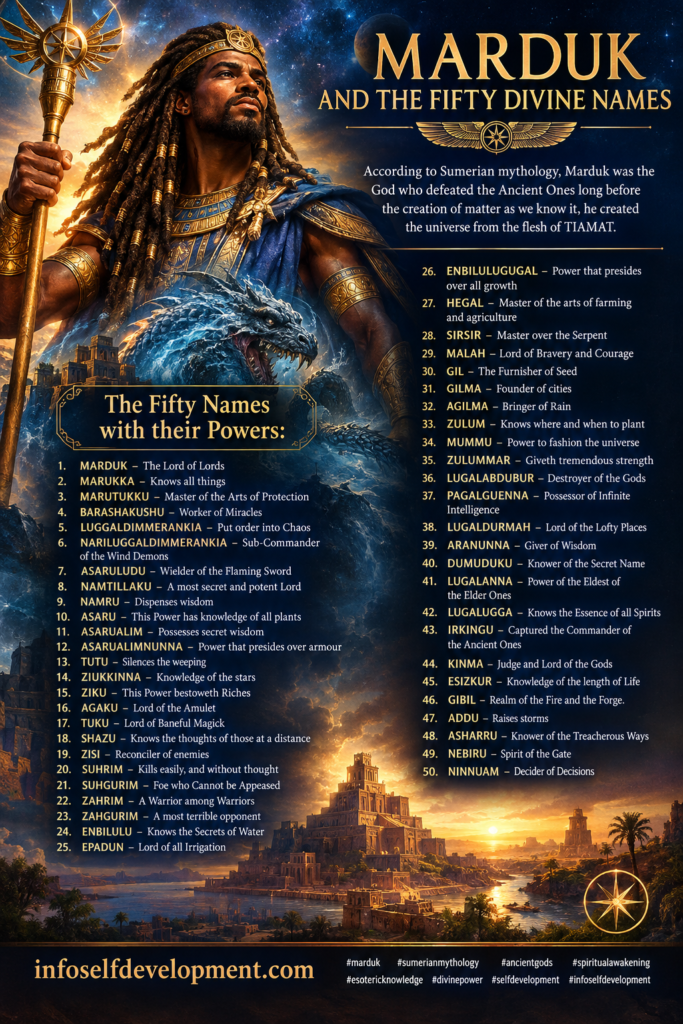
Mesopotamian mythology, divine names and the language of cosmic power
More information about The Fifty Names of Marduk: According to Sumerian mythology, Marduk was the God who defeated the Ancient Ones long before the creation of matter as we know it. Against him in battle were the fierce TIAMAT, KINGU, and AZAG-THOTH. Once he had destroyed these demons, he created the universe from the flesh of TIAMAT, and humanity from the blood of KINGU mixed with his own breath.
You will come across these names in the description of the Fifty Names, which were titles given to Marduk by the Elder Gods after he had helped them to defeat the Ancient Ones.
The Fifty Names here follow, with their Powers:
MARDUK – The Lord of Lords
MARUKKA – Knows all things
MARUTUKKU – Master of the Arts of Protection
BARASHAKUSHU – Worker of Miracles
LUGGALDIMMERANKIA – Put order into Chaos
NARILUGGALDIMMERANKIA – Sub-Commander of the Wind Demons
ASARULUDU – Wielder of the Flaming Sword
NAMTILLAKU – A most secret and potent Lord
NAMRU – Dispenses wisdom
ASARU – This Power has knowledge of all plants
ASARUALIM – Possesses secret wisdom
ASARUALIMNUNNA – Power that presides over armour
TUTU – Silences the weeping
ZIUKKINNA – Knowledge of the stars
ZIKU – This Power bestoweth Riches
AGAKU – Lord of the Amulet
TUKU – Lord of Baneful Magick
SHAZU – Knows the thoughts of those at a distance
ZISI – Reconciler of enemies
SUHRIM – Kills easily, and without thought
SUHGURIM – Foe who Cannot be Appeased
ZAHRIM – A Warrior among Warriors
ZAHGURIM – A most terrible opponent
ENBILULU – Knows the Secrets of Water
EPADUN – Lord of all Irrigation
ENBILULUGUGAL – Power that presides over all growth
HEGAL – Master of the arts of farming and agriculture
SIRSIR – Master over the Serpent
MALAH – Lord of Bravery and Courage
GIL – The Furnisher of Seed
GILMA – Founder of cities
AGILMA – Bringer of Rain
ZULUM – Knows where and when to plant
MUMMU – Power to fashion the universe
ZULUMMAR – Giveth tremendous strength
LUGALABDUBUR – Destroyer of the Gods
PAGALGUENNA – Possessor of Infinite Intelligence
LUGALDURMAH – Lord of the Lofty Places
ARANUNNA – Giver of Wisdom
DUMUDUKU – Knower of the Secret Name
LUGALANNA – Power of the Eldest of the Elder Ones
LUGALUGGA – Knows the Essence of all Spirits
IRKINGU – Captured the Commander of the Ancient Ones
KINMA – Judge and Lord of the Gods
ESIZKUR – Knowledge of the length of Life
GIBIL – Realm of the Fire and the Forge.
ADDU – Raises storms
ASHARRU – Knower of the Treacherous Ways
NEBIRU – Spirit of the Gate
NINNUAM – Decider of Decisions (shirleytwofeathers.com)
Did Egyptian Astrology Come From Mesopotamia?
Ancient Egyptian astrology was not an isolated system. Demotic astronomical and astrological texts preserve evidence of interaction with Mesopotamian and later Greek traditions. The evidence is fragmentary, however, and scholars continue to distinguish between Egypt’s indigenous astronomical traditions and techniques that entered Egypt from elsewhere.
Before the Zodiac: The 36 Egyptian Decans
An older Egyptian system meets the later Mesopotamian zodiac
“..contain a list of decans. The decans represent an indigenous Egyptian astronomical tradition dating back to at least the Tenth Dynasty. Whereas the Mesopotamians divided the sky into twelve portions after the fifth century, the Egyptians had divided the sky into thirty-six sections since about the second millennium. After the advent of Mesopotamian astronomy, the decans were relegated to the realm of astrology, although they may not have originally had any divinatory meaning.
..The influence of Mesopotamia can be discerned in this papyrus, because the decans are presented as subdivisions of the zodiacal signs. The whole composition, however, is introduced by a line which names ‘Imhotep the Great, son of Ptah’ and also ‘Pharaoh Djoser’ written as ‘Tsr’. Presumably the Demotic scribes assigned the decans to the Third Dynasty. Unfortunately, the text may be too broken to determine if they also ascribed the origin of the zodiacal signs to remote antiquity.
..a text which contains omens for the Sun, Moon, and five planets being in Sagittarius or Gemini during the heliacal rising of Sothis or, in one case, its heliacal setting. Dated to the Roman period by palaeography, this text uses zodiacal signs but considers only omens with an effect for the entire country. There are no elements of personal astrology.
..Although the heliacal risings of Sothis have long been considered a particularly Egyptian area of astronomical interest, Mesopotamians also drew omens from the conditions of heliacal risings. In fact, the fiftieth and fifty-first tablets of EAE are dedicated to such omens. Generally, the Mesopotamians watched for early and late risings of fixed stars; but occasionally other phenomena – such as brightness or darkness of the star and the visibility of planets – are considered. Though the positions of planets in zodiacal signs are not explicitly preserved, the omens based on the planets in zodiacal signs are preserved in closely related texts.
..P. Cairo 31222 preserved the planetary order most common to Greek horoscopes. In this respect, it represents a slight divergence from standard Egyptian practice since the Greek planetary order (Sun, Moon, Saturn, Jupiter, Mars, Venus, Mercury) has not been identified as the organizing principal of any Demotic horoscopes. Thus, P. Cairo 31222 recombines ideas and techniques then present in Mesopotamia and perhaps even Egypt. The closest parallels, however, lie in the Greek legacy.
..This brief text contains the name of Mercury and may preserve the triplicity of Gemini, Libra and Aquarius, a triplicity ruled at night by Mercury according to the Greco-Roman era astrologers. Although the connection of triplicities with planets may be described as a Greek phenomenon, triplicities are also known from Mesopotamian texts. Perhaps Egypt played a role in the development of this technique, but more certain evidence must come from a less fragmentary source.
..a difficult piece which listed the influences of Venus and Mercury in each of the twelve topoi. These divisions of the zodiacal signs are unknown among the published Mesopotamian material, but appear frequently in Greek texts.
..Ptolemy records three traditions for these subdivisions of the zodiac. First, Ptolemy describes one system of terms as Egyptian, by which he may have had in mind Nechepso and Petosiris. He describes another system as Chaldaean. Finally, Ptolemy claims to have found a verbose and damaged ancient manuscript which at first he could scarcely understand. After some effort, this manuscript revealed a third, preferred, system of the terms. None of these versions squares with the Demotic copy presented by Depuydt. The fact that the terms published by Depuydt agree with none of these traditions is less surprising than Ptolemy’s claims about an ancient manuscript. It is possible that the manuscript was nothing more than a convention of literary fiction. Indeed, Abu Ma‘shar doubted the story.
..Whether or not the two ceilings of Athribis contain an indication of the zodiacal sign which
occupied the ascendant, the texts consist of a depiction of the zodiac, with the planets positioned in each sign. The zodiacal circles have a beginning indicated by the orientation of the zodiacal signs, and these circles are divided differently in each case. Possibly, the first sign ought to be identified as the ascendant, with each sign occupying an entire house thereafter, but this identification cannot be confirmed because the planetary positions are not equated with a time or date. Alternatively, these ceilings may continue the tradition of the Mesopotamian pseudohoroscopes which did not consider the sign crossing the ascendant.
With the addition of new material some questions are answered. For example, P. Vindob. D. 6286 agrees with the Mesopotamian precedent set by Enuma Anu Enlil. The topoi conform to the ‘whole house’ hypothesis proposed by Robert Hand. However, other questions arise: did Egyptians ascribe an indigenous origin to the zodiacal signs? Did heliacal risings share the same schema presented by Susanne Denningmann? Did the rulerships of the triplicities first appear in Egypt? Did Ptolemy really find the terms listed in an old papyrus? What are the twr and swSp mentioned in the horoscopes? Through a continued process of adding, revising, and interpreting, our knowledge of Demotic astrology will surely continue to grow. (cultureandcosmos.org)
Nechepso and Petosiris
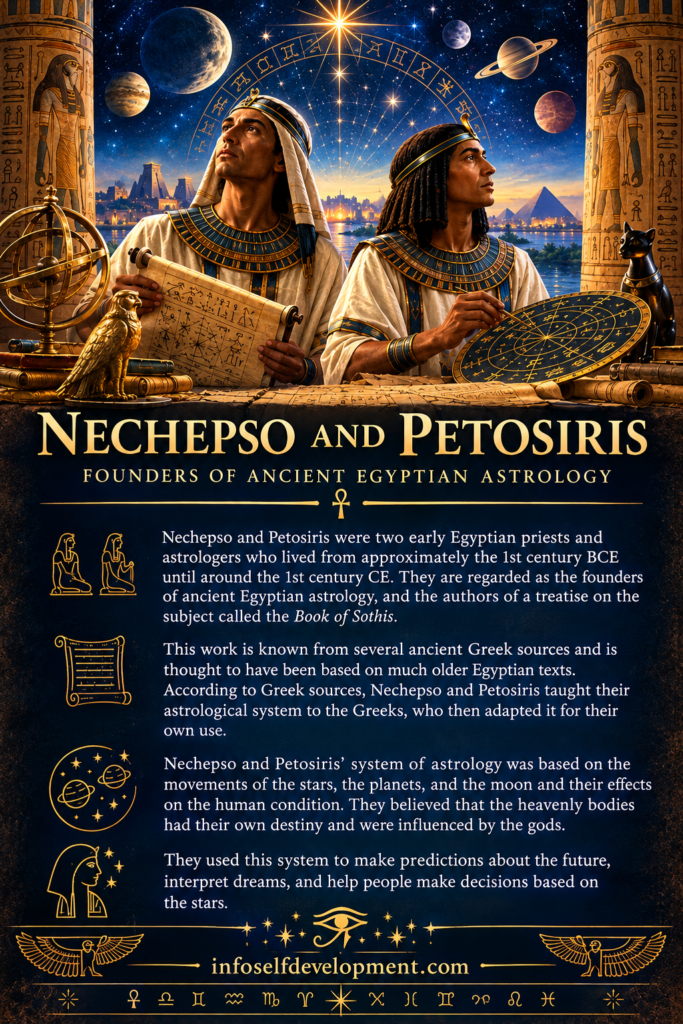
As stated here: world of the free mind – “Nechepso and Petosiris were two early Egyptian priests and astrologers who lived from approximately the 1st century BCE until around the 1st century CE. They are regarded as the founders of ancient Egyptian astrology, and the authors of a treatise on the subject called the Book of Sothis. This work is known from several ancient Greek sources and is thought to have been based on much older Egyptian texts. According to Greek sources, Nechepso and Petosiris taught their astrological system to the Greeks, who then adapted it for their own use. Nechepso and Petosiris’ system of astrology was based on the movements of the stars, the planets, and the moon and their effects on the human condition. They believed that the heavenly bodies had their own destiny and were influenced by the gods. They used this system to make predictions about the future, interpret dreams, and help people make decisions based on the stars.”